By Stephen Relannd

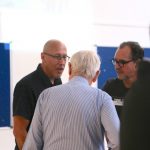
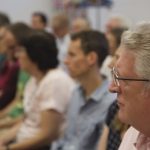
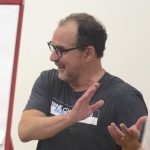
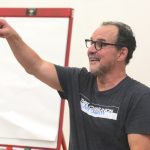
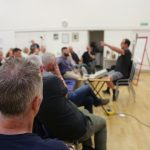
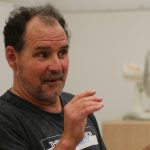
‘A Conversation With Greg Boyd’ was an evening to spearhead training with open theism. Greg answered questions to a packed room regarding alternatives to Augustinian and Calvinist theology and looking at what the Bible actually says. He also tackled questions on not just inter-church issues but also intra-church with churches dealing with the juxtaposition of the culture of the Kingdom and the world’s (in this case UK’s) culture. This ranged from issues of God’s intention for marriage, questions about Jordan Peterson, to not conforming but bridging between the colliding cultures in churches. This assuming the church does not often have God’s Culture, but may be rank with self righteousness. This evening was not an attempt to define open theism, however Greg did provide a framework for open theism – namely that it is rather not about ‘God’ but whether or not people have a choice in life. This stress on choice and God’s knowledge of these different human choices goes hand-in-hand with the great commission and training the next generation.
The importance of this theology was the practical significance of how the narrative of open theism liberates an understanding of modelling an alternative way of life. This narrative of people’s lives makes a difference; possibility is real, we have our own will, not everything comes from God, and we have a far smarter God than we give him credit for which leads to our responsibility to co-labour and train and pray for harvest hands. This is not being utilitarian, or people having ‘the fix to every situation’, but rather each person being faithful to what God has called us to do.
However, this was not to fall into the trap of ‘self righteousness’ of delving deeper into theological rifts as Greg responded to a question about Calvinism and mission. ‘Few people are really practically a Calvinist and honour what many call non open theology’. Nonetheless, he stressed the understanding of open theism leading to practical implications of Christians to avoid living in a way where we twiddle our thumbs and wait for the elected to be saved and leave alone an apparent group of those who are eternally barbequed for God’s pleasure to be left alone, rather than be a people co-labouring with God to bring His Kingdom.
Greg started the evening talking about a global phenomenon of the Bride of Christ linking up all over the world. This collective was likened to neurons finally starting to talk to each other. He emphasised the strength in cross pollination and working in partnership. The implications of this was far more than just a conversation with one person, but rather linking with people of various ages and groups. This ranged from people hearing about open theism for the first time, to veterans such as Roger Forster able to tackle questions with strong scriptural knowledge. This was not meeting for the sake of it but also being intentional and really clear on who we are; not about selling shares for ‘body count’ success or tiptoeing around issues.
This conversation was an inspiration to see training for the next generation to not become stagnant or leaving this to ‘older, bigger leaders’ but move in the fivefold gifting and work together to bring God’s Kingdom. Consequently, as well as a conversation with Greg, this evening also instigated and released in the prophetic an adhesion of the different groups present (Baptists, Pioneer, Ichthus, Methodist, Independents and Anglicans)
It is my feeling that this could all tie together effectively for training for the next generation with the nexus of different groups and paired with a deeper understanding of open theism. As a young person, hitherto this gathering our only viable options for training would not be that of ‘open theism’, nor in London. With such a gathering of experienced people, their respective wealth of knowledge could really impact and help shape the next generation who are concerned with the lack of input and opportunities. My hope is that this training would involve one-to-one mentoring with these individuals for their expertise, with leaders able to host various practical opportunities based on location, plus Biblical teaching from an open theism stance. This would be empowering in gifting of the fivefold ministry, working with all ages, cross-cultural skills, Kingdom values, providing needs in communities, on-going discipleship and church planting. This might include full-time and part-time options in order to include those who have jobs. This is not just an ‘internship’ in original set-ups but rather empowering new wine and new wine skins. I am very hopeful for myself and my peers, and for what this would allow us to do for the Kingdom.




Leave a Reply